


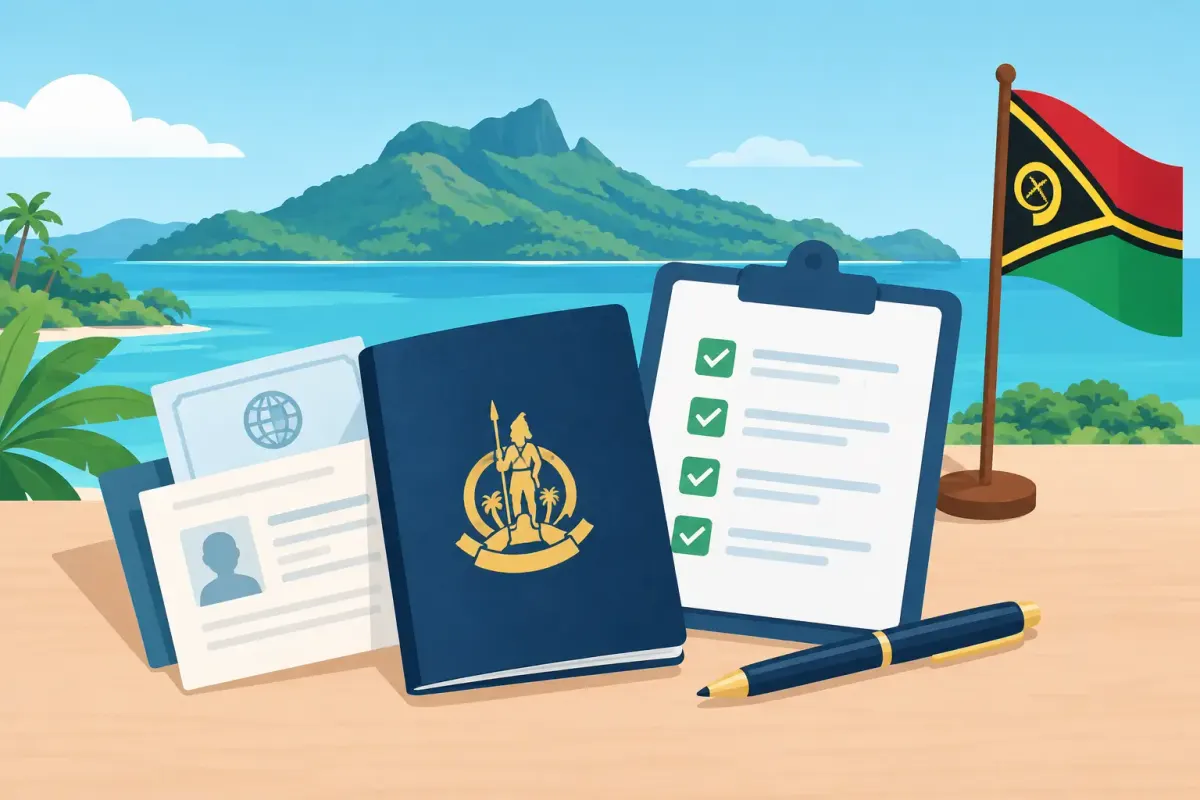
A Vanuatu citizenship application rarely fails because an applicant cannot provide a passport copy. It is delayed when documents tell an incomplete story: a name differs across records, a dependant’s status is not evidenced, or source-of-funds papers do not match the transaction trail. Understanding the Vanuatu citizenship documents required before funds are committed is therefore a practical compliance exercise, not an administrative afterthought.
For internationally mobile families, the objective is simple: provide a coherent, certified record that allows the Citizenship Commission and its due diligence partners to reach a decision without avoidable follow-up. The process can be managed remotely, but the standard of preparation must be exact.
Vanuatu citizenship documents required for every application
The precise file depends on nationality, family composition, professional background and source of wealth. However, every applicant should expect to provide a core identity and civil-status pack. This normally includes:
- A good-quality colour scan of the current passport, certified by a notary public.
- An identity card or driving licence, certified in the same way.
- A certified copy of the birth certificate, and a marriage certificate where a spouse is included.
- A passport photograph, in JPEG or PNG format, meeting standard passport requirements.
- A police clearance certificate from the country of citizenship and, where different, the country of residence.
- A medical certificate from a GP or medical practice confirming good health.
- A CV or personal profile form for every family member aged 18 and over.
- Proof of residential address, such as a recent utility bill.
- A bank reference, issued within the last 12 months by a bank anywhere in the world.
- Employment certification or, if self-employed, a certified statement of self-employment, with supporting statements for the assets declared.
The principal applicant provides this full pack, and the same standard of identity, police clearance and medical evidence applies to each family member included in the application. The official document checklist sets out exactly what each family member needs. A spouse will require their own passport, birth certificate, police clearance and medical documentation. Children require proof of identity and relationship to the principal applicant. For an adult child aged 18 to 25, evidence of full-time education is required; for a dependent parent over 50, the dependency position must be clearly documented.
Civil-status documents must match the family structure
Family applications need more than passports and birth certificates. If a spouse is included, a marriage certificate is required. If there has been a previous marriage, the relevant divorce decree or death certificate must explain the change in status. Where a child has a different surname, or where parental arrangements are not evident from the birth certificate, additional legal or consent documents may be needed.
This is where experienced document review matters. It is better to address a surname variation, transliteration difference or missing middle name at the outset than to allow it to become a question once the file is with the authorities. A short, properly supported explanation can be sufficient, but it should be prepared before lodgement.
Certification, legalisation and translations
A document being genuine is not always enough. The Commission needs documents presented in an acceptable form. Certified copies should be made by an authorised professional under the applicable rules, with clear certification wording, date, signature, name and professional capacity. Poor scans, cropped stamps and expired identification documents are common, preventable causes of delay.
Whether a document needs apostille or legalisation depends on the issuing jurisdiction and the nature of the record. This should be assessed document by document rather than assumed. Applicants with records issued across several countries often benefit from a document matrix that identifies what is available, what must be renewed, and which items require further authentication.
Documents not issued in English should be accompanied by a certified English translation. The translation must be complete, including stamps, annotations and reverse-side text where relevant. Partial translations create uncertainty and are unlikely to help a time-sensitive application.
Keep dates under control
Police certificates, medical reports, bank statements and professional references have practical validity windows. Ordering everything at once can be inefficient if one document takes months to obtain, while waiting until the end may leave the file incomplete. The right approach is to map the long-lead documents first and sequence the remaining papers around the intended lodgement date.
Due diligence documents: the part that needs the most care
Vanuatu citizenship by investment is a government programme, not a document-purchase exercise. Due diligence examines the applicant’s identity, reputation, occupation, business activity and source of funds. The documentary burden is proportionate to the applicant’s profile, but clarity is always more valuable than volume.
A principal applicant should be prepared to evidence how their wealth was created and how the citizenship contribution or investment will be funded. Depending on circumstances, this may involve business ownership records, company accounts, sale agreements, dividend records, employment contracts, tax documentation, audited financial statements or inheritance documents. Personal and business bank statements should support the stated source of funds and show a credible path to the payment.
The key question is consistency. If an applicant’s curriculum vitae describes a technology exit, the file should contain records that support the exit and the subsequent movement of proceeds. If the funds arise from trading profits, dividend distributions or a family business, the explanatory narrative and underlying documents should align. A strong submission anticipates reasonable questions rather than reacting to them later.
Digital-asset holders should expect the same standard of evidential clarity. Payment may be made in USD, USDT, USDC or major cryptocurrencies at no extra cost, but the origin of funds remains subject to due diligence. Wallet records, exchange statements and a documented conversion trail may be relevant where digital assets form part of the source of funds.
Vanuatu citizenship documents required for DSP and CIIP
The documentary and due diligence foundations are substantially the same for the Development Support Programme, or DSP, and the Capital Investment Immigration Programme, or CIIP. The decision between them is chiefly about family structure, capital treatment and purpose.
The DSP costs USD 135,000 all-inclusive for a single applicant, comprising a USD 130,000 contribution and USD 5,000 due diligence fee. A couple costs USD 155,000. Each child under 18 is USD 20,000, while a child aged 18 to 25 in full-time education or a dependent parent over 50 is USD 25,000.
CIIP costs USD 165,000 all-inclusive for a single applicant or a family of up to four: the principal applicant, spouse and two children under 18. This consists of a USD 110,000 contribution, USD 5,000 due diligence fee and a USD 50,000 investment in the Vanuatu Impact Fund. The effective cost is USD 115,000 because the USD 50,000 investment is returned in full after four years, subject to the programme terms. There is no early redemption. Additional children under 18 cost USD 20,000 each, and eligible adult children or dependent parents cost USD 25,000 each.
The Impact Fund supports coffee, cacao, vanilla and kava through more than 300 smallholder farmers. It is independently managed under a capital preservation policy, targets 5–6% a year, and issues annual impact reports. For applicants who want their citizenship decision to include a measurable agricultural-impact component, CIIP adds a distinct purpose to the capital commitment.
From document review to passport issuance
A well-organised application begins with a confidential eligibility and document review. The USD 5,000 due diligence fee is paid on engagement. All remaining amounts, including the USD 50,000 CIIP investment where applicable, are paid in full before lodgement.
Following lodgement, approval is typically received around 60 days later. The oath, biometric appointment and passport issuance generally follow within two to three weeks. There is no residency requirement, language test or interview. The oath can be completed remotely; the only in-person requirement is one biometric appointment in Dubai.
A Vanuatu passport provides visa-free, visa-on-arrival or e-visa access to more than 100 countries. It does not provide visa-free access to the United Kingdom or the Schengen Area. Citizenship can support personal and family mobility planning, but tax treatment depends on tax residency and individual circumstances. Professional tax advice remains essential.
Avoidable issues before lodgement
The fastest route through the programme is not rushing the paperwork. It is identifying inconsistencies early, obtaining current records, and ensuring the financial narrative is supported by primary documents. Applicants should also avoid making travel or business commitments around an assumed passport date. Timelines are well established, but due diligence remains a formal government process.
Stanford Knight & Partners is a government-appointed Master Agent, operating from Port Vila, Dubai and London, with its Port Vila office next to the Citizenship Commission. Its role is to organise the application file before it reaches the Commission, reducing uncertainty before lodgement rather than attempting to resolve it afterwards.
The most useful first step is to gather your current passport, civil-status records and an outline of your source of funds, then review them as one connected file. A citizenship application is strongest when every document answers the next sensible question before it is asked.
Next step
If you would like to know whether Vanuatu is the right route for your family, check your eligibility, see the exact figure for your family in the cost calculator, or book a confidential consultation with one of our senior advisers. Pre-screening is free, and there are no agent fees.
