


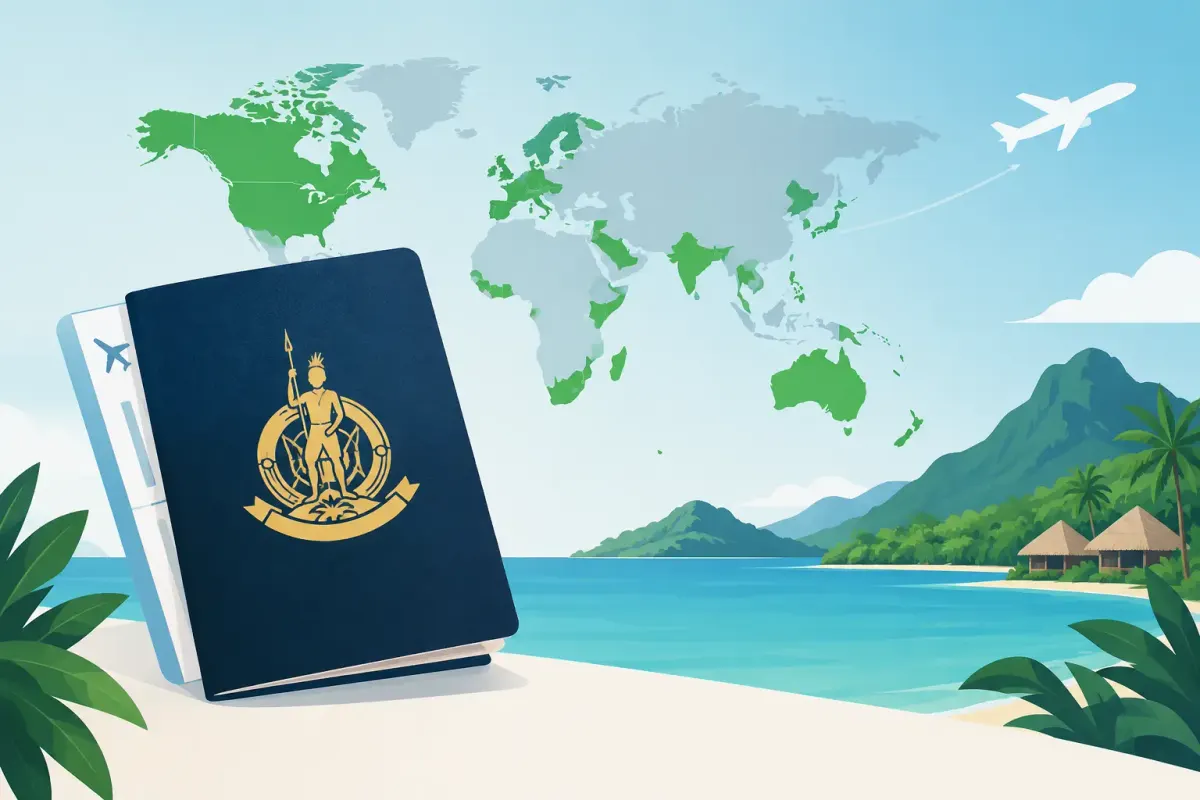
For internationally mobile families, the question behind Vanuatu passport visa free countries is rarely about a holiday alone. It is about whether a second passport creates useful optionality for business travel, short-notice meetings, family mobility and long-term diversification. The honest answer is that Vanuatu offers meaningful access to more than 100 destinations through visa-free, visa-on-arrival and e-visa arrangements, but the category behind each destination matters.
A passport is a serious asset, not a brochure headline. Travel rules change, airline boarding requirements can be stricter than expected, and a visa-free stay does not create a right to work, live or establish tax residence. The value lies in knowing precisely what the passport can do for your own travel pattern before you commit to a citizenship programme.
What Vanuatu passport visa free countries really mean
The phrase "visa free" is often used loosely. In practice, Vanuatu passport holders may encounter three different entry models. Each has a different impact on convenience, planning and travel certainty.
Visa-free entry generally means no visa application is required before departure for a short visit, subject to the destination's permitted stay and border conditions. This is the most straightforward category, though travellers may still need proof of onward travel, accommodation, sufficient funds and a passport with the required remaining validity.
Visa on arrival means the immigration formalities take place at the border. It can be practical for spontaneous travel, but it may involve a form, fee, photograph, local address or evidence of onward travel. It should not be treated as identical to visa-free travel.
An e-visa requires an online application and approval before flying. It is normally more convenient than a conventional embassy application, but it still requires lead time. If a commercial meeting cannot move, that distinction matters.
For this reason, a headline count of 100+ destinations is a starting point, not a decision tool. A founder travelling regularly between Gulf business hubs, Asian financial centres and Caribbean jurisdictions will assess the passport differently from a family using it primarily for leisure travel or a future relocation contingency.
The critical limitation: no UK or Schengen visa-free access
Vanuatu citizenship should be assessed on its present travel merits, not historic assumptions. A Vanuatu passport does not provide visa-free access to the United Kingdom or the Schengen Area.
That point deserves direct treatment because it changes the passport's role for many applicants. If regular short-notice travel to London, Paris, Frankfurt or Milan is central to your life or business, Vanuatu should not be selected on the expectation of visa-free entry to those markets. The relevant destination visa process will still apply.
This does not remove the wider strategic case for a Vanuatu passport. It simply means the passport should sit within a realistic mobility plan. For some clients, its usefulness lies in Asia-Pacific and other accessible regions, flexibility for family travel, or the resilience of holding an additional citizenship. For others, it is a complement to an existing passport rather than a replacement for it.
How to assess the country list properly
The most useful question is not, "How many countries can I enter?" It is, "Can I enter the countries that matter to me, under conditions that fit the way I travel?"
Start by mapping the destinations you actually use. Include headquarters, client markets, suppliers, holiday locations, schools, family connections and transit points. Then classify each destination by entry type, permitted stay, expected processing time and whether the travel is for tourism, meetings or a permitted business activity. Immigration rules can distinguish sharply between attending meetings and undertaking paid work.
Next, consider the operational details. A destination may allow entry without a visa yet require a return ticket, a hotel booking, travel insurance or evidence of funds. Some countries require advance electronic travel authorisation even where no visa is required. Others impose an arrival tax or have passport-validity rules that can prevent boarding if overlooked.
Finally, verify the position shortly before travel. Visa arrangements are sovereign decisions and can change with limited notice. The appropriate check is the official immigration authority for the destination, alongside the airline's current boarding guidance. This matters particularly where a trip involves transit through a third country, as transit rules may differ from entry rules.
Travel access is only one part of passport value
A second citizenship can offer practical redundancy when a family wants more than one route for international travel and future planning. Yet travel access should not be confused with unrestricted global mobility. It does not remove the need for visas where they are required, and it does not bypass border screening, sanctions compliance or destination-specific entry rules.
Nor does citizenship by itself determine a person's tax position. Tax outcomes depend on residence, domicile where relevant, source of income, personal circumstances and the rules of each jurisdiction. Any tax planning should be reviewed with appropriately qualified professional advisers before decisions are made.
For high-net-worth applicants, the strongest decision usually combines mobility with programme credibility, predictable family costs, due-diligence standards and an execution route that does not create unnecessary administrative burden. A passport's travel reach matters, but so does how it was obtained and how confidently it can be presented to banks, counterparties and authorities.
Vanuatu citizenship routes and what stays the same
Both the Development Support Programme, known as DSP, and the Capital Investment Immigration Programme, known as CIIP, lead to Vanuatu citizenship and the same Vanuatu passport. The choice between them is therefore not a choice between different visa-free country lists. It is a choice between programme structure, family composition and whether the applicant wants an impact-investment component.
The DSP costs USD 135,000 all-inclusive for a single applicant, comprising a USD 130,000 contribution and USD 5,000 due diligence fee. A couple costs USD 155,000. Each child under 18 is USD 20,000, while a child aged 18 to 25 in full-time education, or a dependent parent over 50, is USD 25,000.
The CIIP is USD 165,000 all-inclusive for a single applicant or a family of up to four, comprising the principal applicant, spouse and two children under 18. This includes a USD 110,000 contribution, USD 5,000 due diligence fee and USD 50,000 investment in the Vanuatu Impact Fund. With the investment returned in full after four years, subject to the fund terms and with no early redemption, the effective cost is USD 115,000. The fund supports coffee, cacao, vanilla and kava through more than 300 smallholder farmers, targets 5–6% a year and operates under an independently managed capital preservation policy.
In either route, the USD 5,000 due-diligence fee is paid on engagement. All remaining amounts, including the CIIP investment, are paid in full before lodgement. Payments can be made in USD, USDT, USDC or major cryptocurrencies at no additional cost.
There is no residency requirement, interview or language test. Approval is typically around 60 days after lodgement, followed by the oath, biometrics and passport process within a further two to three weeks. The oath can be completed remotely; the sole in-person requirement is one biometric appointment in Dubai. These are expected process timings, not a promise of a fixed issuance date.
A better question before you apply
Before selecting a Vanuatu route, build a destination list and test it against your real life: where you need to be, how quickly you may need to travel, who will travel with you and what entry status each trip requires. Then assess the citizenship programme with the same discipline.
Stanford Knight & Partners is a government-appointed Master Agent focused exclusively on Vanuatu citizenship, with published all-inclusive pricing and direct operational proximity to the Citizenship Commission. That provenance matters when a family is placing compliance, discretion and a second passport in the hands of an adviser.
The right second citizenship does not need exaggerated claims to justify itself. It needs to fit your travel map, withstand proper due diligence and give your family a credible additional option when it is genuinely useful.
Next step
If you would like to know whether Vanuatu is the right route for your family, check your eligibility, see the exact figure for your family in the cost calculator, or book a confidential consultation with one of our senior advisers. Pre-screening is free, and there are no agent fees.
